Managing the Power Game

Power game chess (0)We cannot avoid the influences and effect of power in daily life.  It is a dynamic, complicated byproduct of social interaction and constantly changes even in a single relationship between two people.

How often has the phrase “where do you want to eat?” come up and how often was that decision based on your desire to eat a favorite food versus your lack of interest in making a simple decision?

“I dunno, where do you want to eat?…”

Knowing that power games translate into office politics, leaders need to be able manage the powers to the benefit of the group.  A business cannot be “Lord of the Flies”.  It didn’t go well in the book, it won’t go well in the office. Continue reading

Power in Two Words: “Not Leadership”

Bicep (1)

If you couldn’t tell, I’m a huge advocate of leadership.

It creates value.

It is a force multiplier.

It improves cohesion.

But, contrary to popular misconception…

Power is not leadership.

Leadership, I mean “good” leadership, includes a component of ethics where power is more often a tool wielded to change behavior at whatever cost.

Let’s take an opportunity to examine the relationship of leadership with power and the often post hoc, self-serving narrative people use to justify the misuse of power and to suggest how good leadership, though harder, is a better behavior in the long run. Continue reading

Chris Hadfield’s Guitar

Guitar, Martin DX1 (0a)I, like everyone else, was vastly entertained and totally engaged by Chris Hadfield during his missions assigned to the International Space Station (ISS).

It was a great piece of public outreach that I think captured the world’s attention on science and space.

So, why does this topic show up here? 

Think of it as a thought experiment.

A way to exercise critical thinking skills and follow a line of research.

As I watched Chris’ videos I thought to myself “where the hell did he find a guitar?”
“Did NASA waste money just to get the instrument up there just for Hadfield?”

This is nothing more than an example of following a simple thread of thought that I found interesting.  An example of posing a question (or two) and trying to find reasonable answers. Continue reading

Leadership Programs – The Autopsy

City Morgue (0)“Cause of death?”

“The heart stopped.”

If you are a CSI fan, a fan of the spinoffs, forensic or crime documentaries, or any other show or movie of the genre, you’ve probably watched hundreds of hours of forensic science.

You’re practically a coroner!

Forget all of the testing, the gruesome details of each case, the motives, or the means; the cause of all deaths come down to one final outcome…

The heart stopped.

I can’t say that I have seen hundreds of leadership programs, but I can say that I have been responsible for sponsoring and building, maybe, ten programs from scratch.  I’ve been exposed to others (maybe 30) in an advisory role or as a participant.

In each case, the success or effectiveness of leadership training came down to the question “was the heart still beating?” Continue reading

No, You’re Not a Leader

Leader - a - ManagerSitting in a chair does not make you a leader.

(Not even if it is a really nice chair).

I struggled for a long time over the difference between being a leader and being a manager.  I knew there was an important way to parse the two, but it took me a while to figure it out.

It is a fundamental discussion point for everyone to realize because it is the first step in leadership development.  It is the demarcation point when you invest in your future leaders and potential succession pool.

The nuance leads to planning for responsibilities and expectations.  Some people believe that a place and position is enough and leadership is automatic.  Many people would equate the occupancy of a supervisory position as being a leader.  Leadership is not automatic, but a mindful application of communications, developing relationship, and influence.

The two words are often used as synonyms, but in my mind they are not the same concept.  I’ve always felt that management referred to resources and leadership implied a component of motivation.

If you have a job and you manage time, money, materials, or personnel, you are not a leader.  You are a manager.

Continue reading

Leadership – Unifying the Theory

Leadership Reflection (2)In class, leadership seems all so simple.  It is in black and white.  There are diagrams.  One chapter seems to lead logically to another.  Like any new practical skill, the theory is not the same as practice.  Is leadership a science or is it an art?

Excluding the “mystic” part, I have come to realize that it is a bit of both science and art.

I have been studying leadership since I was 18.  It was MS 101, an introduction to military science.  My first professional career military preparation class as an Army cadet.

As I mentioned in an earlier article, one of the difficulties is the use of the word “leadership”.  It is commonly used, but the context changes as it is used as a noun, verb, adverb, or adjective.  The definition has to be inferred through context.  That makes every article you read confusing and, at times, a seeming contradiction to other articles.

My own experience from the numerous classes, beginning with the first class, is that the instructor will emphasize every aspect of leadership on an equal basis.  From an academic point of view it was because you had to be tested.  The equivalency of everything made prioritizing action based on theory confusing.  The history and theories are interesting, but hard to apply on a daily basis.

Over the years and other classes, I was always surprised to see that there was rarely an overlap from one leadership course to another.  It was confusing because how was it possible for leadership traits and leadership principles to morph from year to year, source to source.  The instructors taught from within their narrowed vision of experience or shared the latest article on “The 10 Secrets of Leadership” which also changed from author to author.

How do you know what to apply?  Can you predict leadership success or failure?

Continue reading

Leadership – Nature vs Nurture

Nature vs Nurture Balance (0)Leadership, like any human attribute, comes down to DNA and culture – Nature versus Nurture.

I am firmly convinced that every skill necessary to be a great leader can, unequivocally, be learned and mastered by anyone.  Full stop.

That is the “Nurture” part.

The skills and the theory represent a limited field of knowledge.  With the proper structuring and the opportunity to develop experience, any person can become a leader.  Many often are, if not in their work place.

Here’s where “Nature” kicks in…

If you ever saw me play basketball, you’d watch with your eyes wide open as your jaw dropped in wonder… you’d be wondering “is he really that bad or is he just clowning around?”  No matter how much nurture I get, I’ll ever overcome my terrible basketball DNA.

There are two kinds of people who will never be good leaders regardless of the training or nurturing.  The ones who shun the responsibility of leadership and the ones who believe that a leadership development class is a confirmation of their greatness and is their first step toward…

WORLD DOMINATION!!

Continue reading

Indiana’s RFRA is not just an LBGT issue, it is bad for business and everyone else

So…

What’s the big deal?  Text box, details of vote and signing
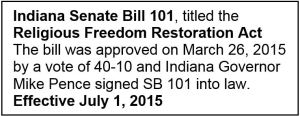
What is the controversy with recent law signed into effect in Indiana last week on 26 March?

The law is called “SB 101 The Religious Freedom Restoration Act” (RFRA).

In the popular press coverage it is called “Indiana’s Anti- LGBT Legislation”.  How did that happen?

One of the interesting facets of current news topics is how they are reported and their social influence.  Sometimes the influence is well below the media hype and sometimes the media focuses on the best click-worthy aspect and misses the wider picture.

I don’t want to get into the politics of “Anti this or that”, but let’s examine the wider picture of the effect of this public policy on business, business issues, review some history, and who I think it affects.

If you asked any American “Should all Americans have religious freedom?”, I’d bet that you would get a near 100% resounding “Yes!”  I mean, the bill passed 40 – 10, a significant margin.

In the fuzziness of our memories, we all know that it is protected by some Constitutional amendment.  (Don’t worry, not testable, I checked for everyone, it is the 1st Amendment.)

In Western Europe, if you asked the same question, they would say yes too, but they would be puzzled by the question.  Most constitutions in Europe list religious freedom as a basic human right and it is not considered a political problem unless public safety become an issue.

When we see something that seems both complex and obvious, you have to do two things: drill down a little to understand it better and step back to see and understand the context.

This is going to be a loooong discussion, if you stop now, I’ll understand.

Otherwise… buckle in. Continue reading

Your Social Media, Marketing Advantage or Threat

DSC07453Maybe some of you are dinosaurs who think social media is a passing fad with only a tangential relationship to your business.

I hate to admit this, but I have seen the birth of many services in the last 20 years that I thought had no chance of making it.  I could not at the time understand the utility of services such as short message services or picture sharing.

I realize now that “utility” was the wrong metric.  The correct measure was emotion.  I finally recognized the feeling that short messages gave me.  It was that same secret thrill of passing notes back in high school.  It was a feeling of inclusion that, in my opinion, is the emotional hook of social media.  The service platforms make the pathways for the messages easy and accessible.

Emotion is the essence of marketing.  When people resonate a product strongly with an emotion, you are building a powerful brand.

So what does this have to do social media?

Social media is a means to engage with your customers.  It can build and strengthen customer relationships and get immediate feedback.  Build the connection of the emotion, build the brand.

  • Measure your brand value by following yourself on social media.
  • Measure your competitors’ brands by following their activities (branding, market share, performance).
  • Follow industry events, conferences.
  • Follow campaign effectiveness and reach.
  • Follow industry influencers and connect with their followers for more reach.

That is the “why” of social media.

The “what” is how are you managing it, especially in a crisis? Continue reading

Bill O’Reilly (Memory Challenge)

One of the hardest comments for anyone to say when speaking of Bill O’Reilly is “I have no opinion about the guy.” He makes it almost impossible to separate the messenger from the message.

Human bias is not part of an intellectual process, it is an emotional one. Almost everyone has a bias regarding O’Reilly. If the bias is positive, people agree with him automatically because he resonates with them emotionally and reinforces the group opinion (several documented biases come into effect that strengthens group membership). If the bias is negative, another group of people disagree, also automatically, with biases that enforce their group feeling.

Full disclosure on my part… My own biases of O’Reilly stem from my perception of his abrasiveness and my lifelong cynicism of self-appointed experts and authorities.

I have to put those aside. Ignore the news hype and make a fair analysis so I can fairly judge O’Reilly and ask the question…

Was Bill O’Reilly really lying?

I recently discussed Bill O’Reilly’s media crisis (here).  He responded to his critics and the crisis terribly.  I also discussed Brian Williams’ crisis and the mitigating circumstances that I believe contributed to a faulty memory recollection that blew up into a media frenzy (here).

Does O’Reilly deserve the same benefit of doubt that I feel Williams deserves?  Do the same mitigating circumstances apply?? Continue reading